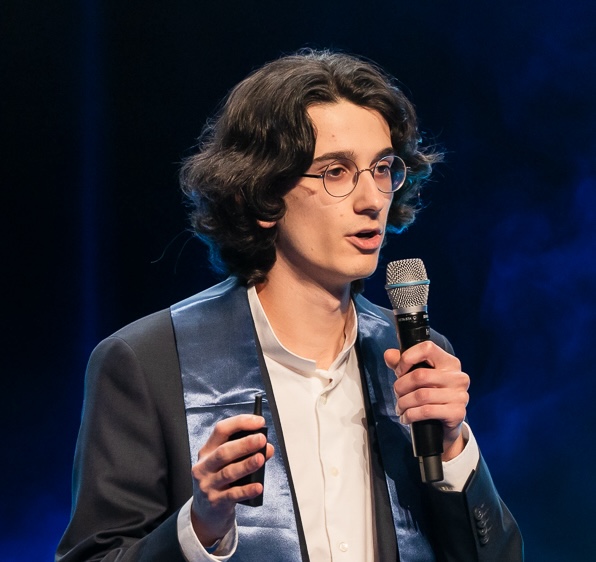
Welcome to my professional page! I am a third year PhD student at LAMSADE, at Université Paris Dauphine-PSL, under the supervision of Florian Yger, Sylvain Chevallier and Fabien Lotte.

My research focuses on Brain Computer Interfaces (BCI), and the goal of my PhD is to learn context invariant representations for EEG data. These representations aim to capture the underlying brain activity independent of external factors, such as environmental conditions, cognitive states (intersession or intersubject variabilities), or task requirements. By removing the influence of context, the obtained representations can enhance the interpretability and generalization capabilities of EEG analysis models.

The tools I use for this work come from the machine learning world, but also from Riemannian geometry. Indeed, a very useful tool used when handling EEG data is its covariance matrix, that lives on the Riemannian manifold of symmetric, positive and definite matrices. Therefore, using geometry-aware algorithms and tools using this specific Riemannian geometry is the gold standard when dealing with EEG data. More generally, I work on probabilistic models and statistics on Riemannian manifolds.

Feel free to contact me if you want to learn more about my research! I also love flan — for a curated list of the ones I have tested, look here.

News

Publications 9

2026

Wrapped One-Class Riemannain EEG classifier for BCI-detection of anesthetic states

Valérie Marissens Cueva*, Thibault de Surrel*, Laurent Bougrain, Seyed Javad Bidgoli, Guy Cheron, Ana Maria Cebolla Alvarez, Claude Meistelman, Fabien Lotte, Florian Yger, Sébastien Rimbert

* Equal contribution

Graz BCI Conference 2026 · PDF · HAL
Abstract

Brain-computer interfaces based on ElectroEncephaloGraphy (EEG) often represent efficiently brain signals as covariance matrices and leverage Riemannian geometry for classification of mental states. However, current approaches typically require multiple classes for training. In many applications such as intraoperative monitoring of consciousness during anesthesia, only data from one class, such as the awake state, may be available, requiring one-class classification methods. We propose a novel Riemannian one-class classifier called the One-Class Wrapped Gaussian. Unlike existing methods that rely solely on the Riemannian mean, our approach incorporates second-order statistical information by using an anisotropic Gaussian-like distribution on the manifold of covariance matrices. We validated our method on EEG data from 19 patients undergoing general anesthesia. Results show that our classifier significantly outperforms state-of-the-art one-class methods for distinguishing between awake and anesthetized states, for clinically relevant electrode numbers. We further demonstrate the robustness of our approach by testing configurations with reduced electrode numbers, confirming its feasibility for real-world surgical settings where electrode placement is constrained.

Riemannian adversarial attacks on Symmetric Positive Definite matrices

Dimitri Timoz, Thibault de Surrel and Florian Yger

ICASSP 2026 · PDF · HAL
Abstract

In this paper, we study adversarial vulnerabilities when inputs lie on the manifold of symmetric positive definite (SPD) matrices by proposing a Riemannian Projected Gradient Descent (R-PGD) attack. This attack performs updates along the affine-invariant geometry and projects using a geodesic budget. We also give a reconstruction procedure that maps adversarial SPD matrices back to the original signals while enforcing spectral constraints. On Brain Computer Interface datasets and SPDNet, R-PGD is more effective than Euclidean PGD and yields geometrically tailored perturbations that remain adversarial after pre-processing. Our results motivate robustness analyses and defenses for manifold deep models.

SPDNet-AE: a Compact SPD Representation through Riemannian Autoencoding

Charlotte Boucherie*, Thibault de Surrel* and Florian Yger

* Equal contribution

ESANN 2026 · PDF · HAL
Abstract

When building dimension reduction methods tailored for Symmetric Positive Definite (SPD) matrices, it is crucial to account for their Riemannian geometry. In this work, we propose an SPDNet-based autoencoder, that we call SPDNet-AE, that learns low-dimensional SPD representations of high-dimensional SPD matrices while preserving the geometry throughout the network. The SPDNet-AE is built using the BiMap layer of the SPDNet, but we allow it to have multiple channels. We show that our SPDNet-AE is able to learn a useful low-dimensional representation of the data for classification (without any class information). Moreover, we show that with a comparable number of parameters, a classical Euclidean autoencoder is not able to learn and maintain the SPD constraint on the input matrices.

2025

A probabilistic view on Riemannian machine learning models for SPD matrices

Thibault de Surrel, Florian Yger, Fabien Lotte and Sylvain Chevallier

Geometric Science of Information (GSI) · PDF · HAL
Abstract

The goal of this paper is to show how different machine learning tools on the Riemannian manifold $\mathcal{P}_d$ of Symmetric Positive Definite (SPD) matrices can be united under a probabilistic framework. For this, we will need several Gaussian distributions defined on $\mathcal{P}_d$. We will show how popular classifiers on $\mathcal{P}_d$ can be reinterpreted as Bayes Classifiers using these Gaussian distributions. These distributions will also be used for outlier detection and dimension reduction. By showing that those distributions are pervasive in the tools used on $\mathcal{P}_d$, we allow for other machine learning tools to be extended to $\mathcal{P}_d$.

Interpretability of Riemannian tools used in Brain Computer Interfaces

Thibault de Surrel, Tristan Venot, Marie-Constance Corsi and Florian Yger

IEEE Machine Learning For Signal Processing (MLSP) · PDF · HAL
Abstract

Riemannian methods have established themselves as state-of-the-art approaches in Brain-Computer Interfaces (BCI) in terms of performance. However, their adoption by experimenters is often hindered by a lack of interpretability. In this work, we propose a set of tools designed to enhance practitioners’ understanding of the decisions made by Riemannian methods. Specifically, we develop techniques to quantify and visualize the influence of the different sensors on classification outcomes. Our approach includes a visualization tool for high-dimensional covariance matrices, a classifier-agnostic tool that focuses on the classification process, as well as methods that leverage the data’s topology to better characterize the role of each sensor. We demonstrate these tools on a specific dataset and provide Python code to facilitate their use by practitioners, thereby promoting the adoption of Riemannian methods in BCI.

Wrapped Gaussian on the manifold of Symmetric Positive Definite Matrices

Thibault de Surrel, Fabien Lotte, Sylvain Chevallier and Florian Yger

International Conference on Machine Learning (ICML) · PDF · HAL
Abstract

Circular and non-flat data distributions are prevalent across diverse domains of data science, yet their specific geometric structures often remain underutilized in machine learning frameworks. A principled approach to accounting for the underlying geometry of such data is pivotal, particularly when extending statistical models, like the pervasive Gaussian distribution. In this work, we tackle those issue by focusing on the manifold of symmetric positive definite matrices, a key focus in information geometry. We introduced a non-isotropic wrapped Gaussian by leveraging the exponential map, we derive theoretical properties of this distribution and propose a maximum likelihood framework for parameter estimation. Furthermore, we reinterpret established classifiers on SPD through a probabilistic lens and introduce new classifiers based on the wrapped Gaussian model. Experiments on synthetic and real-world datasets demonstrate the robustness and flexibility of this geometry-aware distribution, underscoring its potential to advance manifold-based data analysis. This work lays the groundwork for extending classical machine learning and statistical methods to more complex and structured data.

Geometry-Aware visualization of high dimensional Symmetric Positive Definite matrices

Thibault de Surrel, Sylvain Chevallier, Fabien Lotte and Florian Yger

Transactions on Machine Learning Research · PDF · HAL
Abstract

Symmetric Positive Definite (SPD) matrices are pervasive in machine learning, from data features (such as covariance matrices) to optimization process. These matrices induce a Riemannian structure, where the curvature plays a critical role in the success of approaches based on those geometries. Yet, for ML practitioners wanting to visualize SPD matrices, the existing (flat) Euclidean approaches will hide the curvature of the manifold. To overcome this lack of expressivity in the existing algorithms, we introduce Riemannian versions of two state-of-the-art techniques, namely t-SNE and Multidimensional Scaling. Therefore, we are able to reduce a set of $c \times c$ SPD matrices into a set of $2 \times 2$ SPD matrices in order to capture the curvature information and avoid any distortion induced by flattening the representation in a Euclidean setup. Moreover, our approaches pave the way for targeting more general dimensionality reduction applications while preserving the geometry of the data. We performed experiments on controlled synthetic dataset to ensure that the low-dimensional representation preserves the geometric properties of both SPD Gaussian and geodesics. We also conduct experiments on various real datasets, such as video, anomaly detection, brain signal and others.

2024

Averaging trajectories on the manifold of symmetric positive definite matrices

Thibault de Surrel, Florian Yger, Sylvain Chevallier and Fabien Lotte

EUSIPCO · PDF · HAL
Abstract

The goal of this paper is to leverage more information from a single measurement (e.g. an ElectroEncephalo-Graphic (EEG) trial) by representing it as a trajectory of covariance matrices (indexed by time for example) instead of a single aggregated one. Doing so, we aim at reducing the impact of non-stationarities and variabilities (e.g. due to fatigue or stress for EEG). Covariance matrices being symmetric positive definite (SPD) matrices, we present two algorithms to classify trajectories on the space of SPD matrices. These algorithms consist in computing, in two different ways, the mean trajectory of a set of training trajectories and use them as class prototypes. The first method computes a pointwise mean and the second one achieves a smart matching using the Dynamic Time Warping (DTW) algorithm. As we are considering SPD matrices, the geometry used along these processes is the Riemannian geometry of the SPD matrices. We tested our algorithms on synthetic data and on EEG data from six different datasets. We show that our algorithms yield better average results than the state-of-the-art classifier for EEG data.

2022

RipsNet: a general architecture for fast and robust estimation of the persistent homology of point clouds

Thibault de Surrel, Felix Hensel, Mathieu Carrière, Théo Lacombe, Yuichi Ike, Hiroaki Kurihara, Marc Glisse and Frédéric Chazal

Proceedings of Topological, Algebraic, and Geometric Learning Workshops · PDF · HAL · arXiv
Abstract

The use of topological descriptors in modern machine learning applications, such as Persistence Diagrams (PDs) arising from Topological Data Analysis (TDA), has shown great potential in various domains. However, their practical use in applications is often hindered by two major limitations: the computational complexity required to compute such descriptors exactly, and their sensitivity to even low-level proportions of outliers. In this work, we propose to bypass these two burdens in a data-driven setting by entrusting the estimation of (vectorization of) PDs built on top of point clouds to a neural network architecture that we call RipsNet. Once trained on a given data set, RipsNet can estimate topological descriptors on test data very efficiently with generalization capacity. Furthermore, we prove that RipsNet is robust to input perturbations in terms of the 1-Wasserstein distance, a major improvement over the standard computation of PDs that only enjoys Hausdorff stability, yielding RipsNet to substantially outperform exactly-computed PDs in noisy settings. We showcase the use of RipsNet on both synthetic and real-world data.

Teaching

Linear Models and their Generalizations

TD — M1 Mathematics · Université Paris Dauphine-PSL
Teaching supervisor: Katia Meziani
2025

Statistiques mathématiques

TD — Licence 3 · Université Paris Dauphine-PSL
Teaching supervisor: Vincent Rivoirard
2024 · 2025 · 2026

Méthodes numériques — Introduction à l'analyse numérique et au calcul scientifique

TD/TP — Licence 2 · Université Paris Dauphine-PSL
Teaching supervisor: Guillaume Legendre
2024 · 2025

Fondement du Machine Learning

TD/TP — Licence 3 · Université Paris Dauphine-PSL
Teaching supervisor: Clément Royer
2024